

Recorded in 1978-79 and released on November 21, 1980, Gaucho stands as one of the most meticulously crafted albums in popular music history. Created by Steely Dan—the studio-focused partnership of Donald Fagen and Walter Becker—the record represents both the peak of their perfectionism and a turning point in music production technology.
At the center of its story is an unlikely “musician”: A custom-built drum machine named Wendel, invented by late recording engineer Roger Nichols (1944-2011), which would go on to receive its very own RIAA Platinum Album award.

Roger Nichols and Wendel's RIAA Awards for Steely Dan's Gaucho album, along with the drum machine itself and some of Nichols' Grammy® Awards (photo courtesy Cimcie Nichols)
By the time Gaucho was recorded, Steely Dan had already earned a reputation for obsessive studio precision. Their previous album, Aja, had set a new benchmark for sonic clarity, but Gaucho pushed that ethos even further. The sessions stretched across multiple studios, involved dozens of elite session musicians, and were plagued by setbacks—lost tapes, legal disputes, and personal turmoil. Yet the most persistent challenge was rhythmic: Becker and Fagen were dissatisfied with the feel and consistency of even the best drummers available.
Rather than compromise, they turned to Nichols with an unusual request. They wanted a way to achieve flawless timing while retaining the full, natural sound of real drums. As Fagen later recalled in a 2006 interview for Sound on Sound magazine, the idea was essentially to create “a machine to play the beat we want.” Nichols’ response was bold: he could build such a machine—but it would cost $150,000 and require weeks of development. The band agreed, funding the project out of the album’s recording budget.
What Nichols delivered was Wendel, a pioneering digital drum sampling system developed in 1978. Unlike primitive drum machines of the era, Wendel did not rely on synthetic tones. Instead, it sampled real drum hits—kick, snare, hi-hat—and allowed engineers to manipulate them with unprecedented precision. Each element of a drum performance could be adjusted independently, enabling subtle shifts in timing and feel without re-recording entire takes.
Technically, Wendel was groundbreaking. Built using early computer hardware and programmed in assembly language, it required painstaking effort—sometimes taking minutes just to code a single drum hit. Yet the payoff was enormous. For the first time, producers could construct rhythm tracks that combined the authenticity of live performance with the exactitude of a machine. Nichols had effectively invented a new form of digital sampling-- before such techniques became standard in music production.
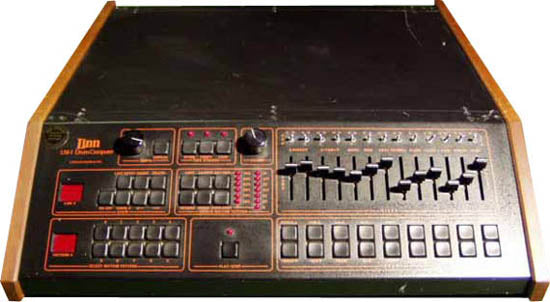
Nichols developed his invention prior to the release of the first commercially available drum machine, the Linn LM-1 Drum Computer, which came out in 1980
On Gaucho, Wendel was used prominently on tracks like “Hey Nineteen,” “Glamour Profession,” and “My Rival.” In these songs, the machine provided the foundational drum patterns, while live drummers added fills and embellishments. The result was a hybrid sound—tight, polished, and slightly uncanny—that became one of the album’s defining characteristics.
Other tracks, such as “Babylon Sisters,” “Time Out of Mind”, and “Third World Man” relied on traditional drumming from top session drummers such as Steve Gadd, Jeff Porcaro, and Bernard Purdie, highlighting the contrast between human groove and machine precision.
The use of Wendel reflected a broader artistic vision. Becker and Fagen were not simply chasing perfection for its own sake; they were responding to the changing musical landscape of the late 1970s. Disco and pop records were increasingly defined by steady, mechanical rhythms, and Gaucho can be seen as Steely Dan’s sophisticated response—melding jazz harmony and lyrical irony with cutting-edge studio technology. The album’s sleek, almost clinical sound mirrored its themes of decadence, alienation, and fading glamour in a new decade.
Despite—or perhaps because of—its difficult creation, Gaucho was a commercial success. It produced the hit single “Hey Nineteen” and ultimately sold over one million copies in the United States. With that achievement came an unprecedented honor: the RIAA awarded a Platinum Album award not only to Nichols and the band, but also to Wendel itself.
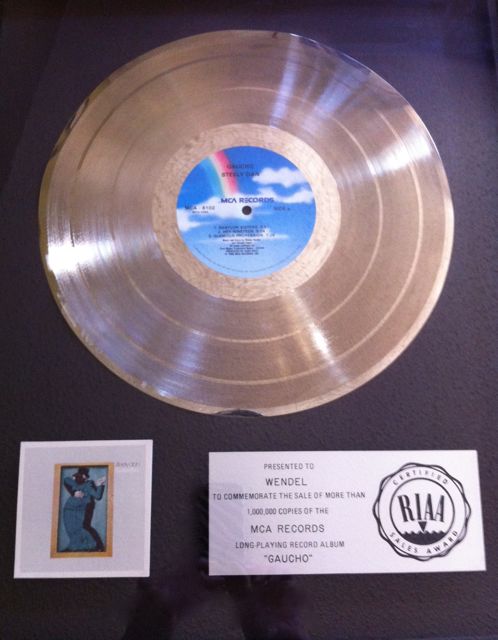
Wendel's RIAA Platinum Album award for Steely Dan album Gaucho, the first (but possibly not the last...) time an award will be presented to a machine (photo courtesy Gopita, CC BY-SA 3.0, via Wikimedia Commons)
This unusual recognition underscored just how central the machine had been to the album. Wendel was not merely a tool; it was, in a sense, a performer. In the liner notes of later reissues, Steely Dan even anthropomorphized it, describing the device as a dependable, almost human collaborator. It remains one of the only pieces of studio equipment ever to receive such an accolade, symbolizing a moment when technology crossed into the realm of artistry.
The legacy of Wendel extends far beyond Gaucho. Nichols’ invention laid the groundwork for modern digital sampling, drum replacement, and sequenced music production. Today’s producers routinely manipulate audio with software that owes a conceptual debt to Wendel’s design. What was once a laborious, experimental process has become a standard part of recording.

For Steely Dan, however, Gaucho was both a triumph and marked the end of an era. The album won Nichols a Grammy Award for Best Engineered Recording – Non-Classical, and was also nominated for Album of the Year and Best Pop Performance by a Duo or Group with Vocals. But after its release, Becker and Fagen would take a lengthy hiatus, not reconvening as a band until the late 1990s. In retrospect, the album can be seen as both a culmination and a breaking point—a project where the pursuit of perfection reached its logical extreme.
Yet Gaucho endures as a singular achievement. Its smooth surfaces conceal an intense, often chaotic creative process, and its innovations continue to resonate in contemporary music. At the heart of it all is Wendel, the drum machine that helped redefine what was possible in the studio—and, remarkably, earned its place alongside human musicians in the annals of recording history.
Interested in genuine RIAA Gold and Platinum and other record awards including (at time of article posting) a RIAA Platinum Album award for Steely Dan's Gaucho? Check out our selection here. We typically have several hundred in stock.
See an exclusive collection of 1970s Steely Dan photos taken in the studios they recorded in by their engineer Roger Nichols here.
Want more content like this? If you're not a subscriber already, sign up for our free MusicGoldmine newsletter which comes out once a week. Go here to sign up and also get a code for 15% off your first purchase and our 100+ page MusicGoldmine Record Award Guide.
Be the envy of all your friends! Get MusicGoldmine.com Music History in your Facebook feed each day. Just follow us on Facebook here.
Image Credits:
Wendel and Roger Nichols RIAA awards, Grammy awards, drum machine photo: Cimcie Nichols
Wendel-presented RIAA award for Gaucho close up photo: Gopita, CC BY-SA 3.0, via Wikimedia Commons
MCA Records-presented RIAA award photo: ©2026 MusicGoldmine.com
Linn Drum Machine photo: Public domain