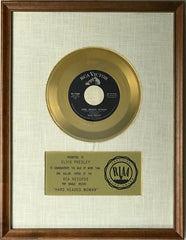
 In the history of recorded music, the iconic gold and platinum records that adorn the walls of recording studios, artist's homes, and music professional's offices have become some of the most recognizable symbols of commercial success. Most people immediately associate these plaques with the Recording Industry Association of America (RIAA)—the trade organization that, beginning in 1958, formalized sales recognition in the United States. Yet nestled within the annals of music memorabilia is a lesser-known but historically fascinating chapter: The in-house record awards made by Disc Award Ltd. throughout the 1960s and 1970s.
And, as you'll see from photos of some of these 50+ year old awards, they are still quite beautiful symbols of success with a design and construction quality that many collectors feel surpasses that of RIAA awards.

Classic award design, quality materials and construction have kept Disc Award Ltd. awards a favorite of collectors for five decades
The Origins of Disc Award Ltd.
Disc Award Ltd. was a Los Angeles–based manufacturer of non-RIAA “in-house” record awards that operated primarily from the late 1950s through the late 1970s. These awards were typically commissioned by record labels, artist management, radio stations, or industry personnel to commemorate strong sales or promotional success for singles or albums.
Unlike official RIAA certifications, which required an audit and certification process, Disc Award Ltd. plaques were custom-produced at the request of labels to celebrate milestones or achievements the label wished to highlight.
Label vs. RIAA Awards: Differentiating the Honors
To fully appreciate Disc Award Ltd., it helps to understand the context of "gold" and "platinum" record awards during this era. The RIAA’s certification program, launched in 1958, was designed to standardize commercial recognition: an RIAA Gold album initially represented $1 million in retail sales, while certification thresholds evolved over time, including changes in the mid-1970s that shifted the focus to units sold.
However, label-issued or “in-house” awards like those from Disc Award Ltd. did not go through the RIAA’s auditing process. Instead, labels commissioned these plaques to reward internal teams, industry partners, or artists without the formalities of the RIAA standards. Such awards typically lacked the RIAA seal and would instead carry the label’s brand and personalized dedication text.
Thus Disc Award Ltd. awards were especially popular during the pre-"platinum" era when the RIAA standards were evolving and their official Platinum program had not yet been developed. The RIAA didn't launch Platinum awards until 1976, with the first Platinum album certification issued being for the Eagles Their Greatest Hits 1971-75, which attained Platinum status for one million copies sold on February 24, 1976. Incidentally, while it was the first Platinum album award issued, that Eagles release actually today holds the top spot on the RIAA's list of top selling albums as of the writing of this article, having been just certified on January 22, 2026 at a staggering 40 million sold.

While Disc Award Ltd. made "gold" album awards like the example for Bread above, they also made "platinum" awards like the below Barry White album award before the RIAA launched their official Platinum certification program in 1976

So, while the RIAA was only issuing Gold record awards, Disc Award Ltd. manufactured both "gold" and "platinum" awards for labels, artist management, and others upon request. While the awards didn't have the RIAA's fully objective sales audits behind them, they were in large part only issued when there were in fact major sales levels that the industry wanted to celebrate.
By the way--what were the sales standards the RIAA established in 1976 for Platinum awards? While Gold Album awards were issued for audited sales of 500,000 copies and Gold Singles one million copies sold, the new Platinum awards were of course higher. Initially, Platinum Album awards were issued for one million copies sold and Platinum Single awards were issued for two million copies sold. However, by 1989 the sales level for Singles also became one million due to declining sales of the format.
In this environment, Disc Award Ltd. provided custom, high-quality commemorative pieces that served both as publicity tools and personal tokens of appreciation within the music business. It's also important to note that in some cases, the record label ordering awards desired to recognize worldwide sales. For example, the two awards issued below for The DeFranco Family's 1969 hit "Heartbeat - It's A Lovebeat" were issued to recognize the multi-country success of the Canadian group's single, which, despite its' success, actually never received a U.S. Gold or Platinum RIAA certification.

20th Century Records celebrated the success of The DeFranco Family's 1973 single by ordering both "gold" and "platinum awards" from Disc Award Ltd.

Design and Signature Style
Disc Award Ltd. plaques were distinctive. Typically, they featured a gold-toned record disc mounted on a felt matte—often black—with a framed plaque that included an engraved dedication plate, although not always as seen in one example below. Awards bore the now-recognizable Disc Award Ltd. “dragon” logo etched into the dead wax of the disc, setting them apart visually from other awards.

Disc Award Ltd. gold or platinum records always included their distinctive dragon logo in the dead wax area of the disc - this is the "early font" version from a 1965 award for The Byrds

While the dragon logo stayed the same, the font used for "Disc Award Ltd." was updated on awards made later in the 1960s into the 70s
In terms of aesthetic, these awards tended to have a classic, understated elegance—a contrast to later custom awards that would become bolder and more complex in the 1980s and beyond. Collectors today often remark that these pieces represent the “gold standard” of pre-RIAA custom awards, prized for their rarity and connection to the heyday of vinyl.
In many cases, the collectability and historical interest of these in-house awards come precisely because they reflect the internal culture of music companies and provide a window into how success was celebrated by those closest to the creative process.

If you're collecting Disc Award Ltd. awards and seeking to determine authenticity, note that their solid wood backs were typically taped with regular masking tape, and featured a rubber-stamped company address and serial number

More examples from the Golden Era
Although Disc Award Ltd. didn’t publicly document a comprehensive list of all awards they made, numerous surviving examples illustrate the breadth of artists and milestones commemorated. Here's a few more:
The Doors debut album: A Disc Award Ltd. gold record was produced on 1967-68 to celebrate the group's debut album sales of more than 500,000 copies—a milestone that coincided with the album’s #2 position on the Billboard charts and hit singles like “Light My Fire.” This award was presented to Elektra Records’ national promotion director:

Three Dog Night: A Disc Award Ltd. plaque for the 1973 album Cyan commemorated substantial commercial success (note that sometimes Disc Award Ltd awards did not included a presentation plate):

Elton John: Sir Elton's 1973 album Honky Chateau, best known perhaps for legendary track "Rocket Man", along with other hit "Honky Cat", was recognized by Uni Records with this Disc Award Ltd. gold plaque:

America: A Disc Award Ltd. gold record was produced to recognize America’s 1974 Holiday album, featuring hits like “Tin Man” and “Lonely People,” which charted strongly on the Billboard Hot 100 and helped the album reach high positions on the Top 200. This award was presented to a radio music director and remains a sought-after artifact today.

Many gold 45 awards were made by Disc Award Ltd. - here are a few more examples:


These examples reflect the range of artists and genres honored—reflecting the vibrant musical landscape of late-60s and early-70s rock, folk, country, and pop.
Cultural Importance and Collecting Today
In recent years, Disc Award Ltd. plaques have become collectible artifacts among music memorabilia enthusiasts. Because they were made in relatively limited numbers and often tied to specific promotional campaigns, these awards rarely surface on the open market. When they do, they attract attention not just for their aesthetic quality but for the stories they represent: artists on the cusp of fame, label executives commemorating milestones, and radio personalities rewarded for supporting breakout hits.
Collectors particularly prize pieces that celebrate milestone records from iconic artists of the 60s and 70s—eras in which rock and pop music were undergoing seismic changes. A Disc Award Ltd. award for a classic rock LP or hit single doesn’t just symbolize sales success; it captures a moment in music history when records moved millions of listeners and reshaped cultural norms.
Moreover, these awards help illustrate how the music industry’s recognition infrastructure evolved. While the RIAA would eventually dominate as the official certifier of sales achievements, early custom awards like those produced by Disc Award Ltd. remind us that celebration of success was always more than a numbers game—it was about fostering relationships, building careers, and acknowledging contributions within a tightly knit industry community.
By the late 1970s, the RIAA’s system had become sufficiently standardized and widely recognized that there was less need for outside manufacturers to create label-specific plaques. Disc Award Ltd. gradually faded from prominence as artists and labels increasingly adopted official RIAA certifications for marketing and public recognition.
Yet the awards that remain—often hidden in attics and personal collections (or e-stores like ours)--continue to tell stories of an era when the record business was booming, vinyl was king, and every gold platter symbolized a connection between artist and audience. Today, for music historians and collectors alike, Disc Award Ltd. awards are more than memorabilia: they are artifacts that capture the heart of the music business during one of its most creative and commercially explosive periods.
One final note--Awards of a very similar design to Disc Award Ltd. plaques were made in the 1970s by other manufacturers, mostly for MCA Records. Here's an example but note that the frames were made of metal, not wood, and no Disc Award Ltd. dragon logo appears on the record discs. Still attractive and collectible, but they lacked some of the quality and details of Disc Award Ltd. awards:

Check out our current selection of RIAA and other record awards for sale here and, when we have them, you can find any Disc Award Ltd. plaques we currently have in stock here.
Want more content like this? If you're not a subscriber already, sign up for our free MusicGoldmine newsletter which comes out once a week. Go here to sign up plus get a code for 15% off your first purchase.
Be the envy of all your friends! Get MusicGoldmine.com Music History in your Facebook feed each day. Just follow us on Facebook here.
All photos © MusicGoldmine.com 2018-2026